Back in the fall, I attended the exhibit Fragments of Epic Memory at the Art Gallery of Ontario. I promptly misplaced my notes, only to relocate them as I was organizing myself for assessment.
There were a number of exhibits, of various sizes, going on in parallel. I’ve collected all my notes from my visit, here.
Exhibit: Fragments of Epic Memory
When the AGO holds a major exhibit, they often times show an installation or collection of works in Walker Court. As visitors to the gallery move into the gallery, they encounter whatever has taken residence in this court.
Ové’s installation Moko Jumbie was arresting, and I spent a few minutes (badly) sketching it into my notebook before moving up to the exhibit proper. I’m not sure how to articulate what I experienced. To me the figure was a personified exuberance. The metallic shine, and the multiple faces forcing attention and engagement like a divine entity.


I spent a long time in front of Bowling’s Middle Passage. It occupied pride of place at one end of the exhibit. Chairs were set up directly in front of the piece allowing viewers to take their time, and I accepted that invitation. I found it interesting how many people simply walked past instead.
When I sat down, I decided to sit and record my notes as they came to my mind. I chose not to read anything about this work until I had reached some form of “finality” in my own responses.
What those notes recorded was my realization and appreciation of the visual layers in the pieces. Faces revealed photography, drips told me of the orientation of the process. I can see explosions and war themes. I can see the west of Africa and the East of South America revealing the expanse of the Atlantic. I can see Africa on its side in the midst of the Atlantic.
I wondered if the images were about the world wars, but the resolution of the geographies told me about slave trade.
I spent maybe 20 minutes with the piece before moving on.
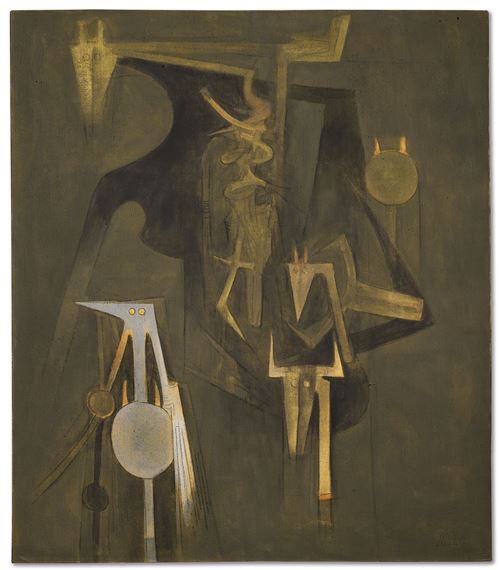
I see so many cubist and surrealist forms I’m reminded of Picasso, and then further reminded about where Picasso and his peers pulled their inspiration: the shapes and geometries of African art.
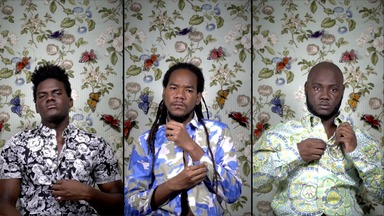
In one room of the exhibit was the video installation Three Kings Weep. Again, like Middle Passage I sat and took notes prior to reading any material.
The video shows three male presenting individuals. The film was recorded in reverse, as the participants undressed. As I sat through video garments and jewelry flew in from off screen, where they were dropped, and wrapped themselves back onto the individuals. Simultaneously, they cried — as their clothing was more present, their tears dried up. Progressively, the individuals were flashier and flashier, and I asked if the individuals were at a funeral? The room that i saw in was also arranged as a church, and I saw on a pew-like bench. On the backdrop, the butterflies move. I could hear words, vaguely, but could only make out the words “brave”.
I got the sense that the clothing was their armor. That as they stripped it off, they were forced to confront their feelings and fears as expressed with their tears.
I watched the loop through multiple times.
Exhibit: Dawoud Bey, John Edmonds, Wardell Milan
A small one-room exhibit, with a handful of large pieces. In my notes, two works caught my attention.
Dawoud Bey’s Untitled #20 is unapologetically dark. Froma distance it was quite difficult to see the subject, and instead if read as a almost abstract piece. Up close, details rose from the gloom. It was very much like approaching an house in late rural twilight. I’m not sure if it was intentionally, but I read threat in that darkness. Perhaps that is my affluent white indoctrination speaking.
Wardell Milan’s Miohael Ross I took note of note via words, in my notebook, but via a sketch of the eyes. It is a collage piece, and I recently had had conversations around collage with my tutor. This artist’s surrealistic recreation of a human head via collage caught my attention immediately. As I look at the piece, I catch my eyes trying to construct a ‘complete’ head from the assemblage, and always failing and yet at the same time the collected whoel reads as a head. If I look at the image with my peripheral vision, my brain dutifully fills in the gaps and I can resolve a complete head that evaporates the moment I move my eyes. Fascinating.

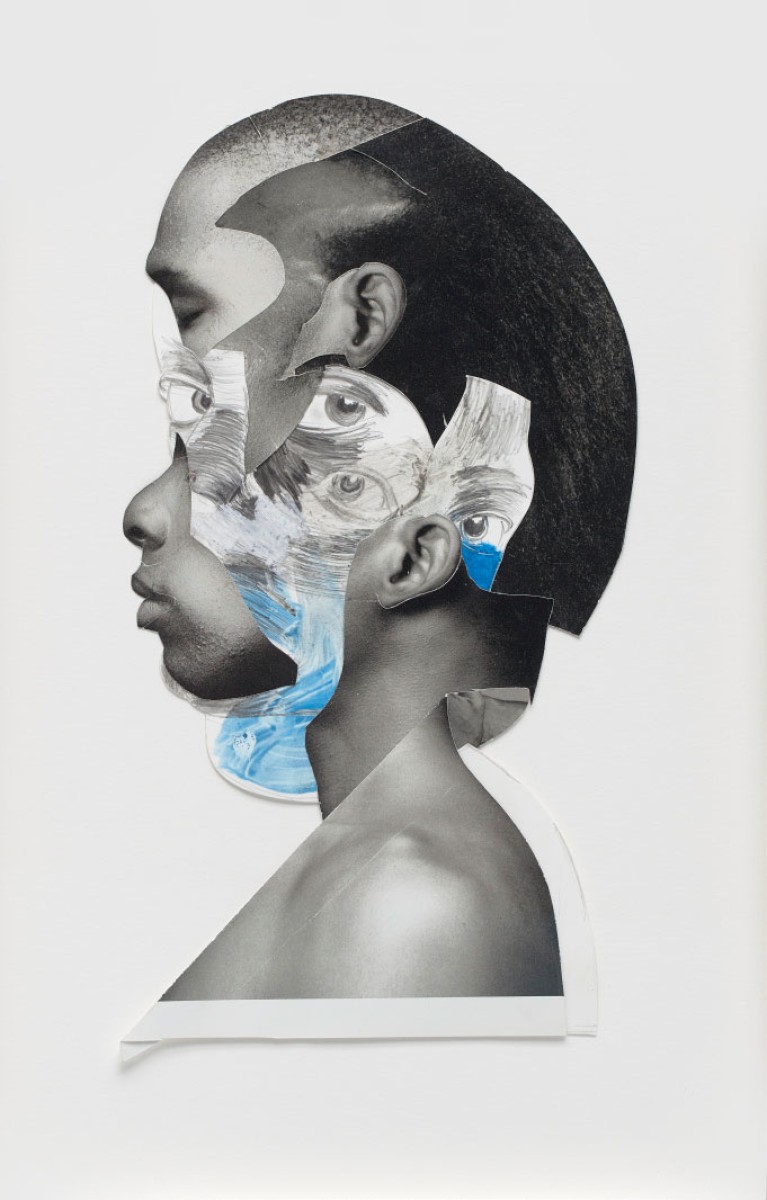
Exhibit: Documents, 1960s –1970s
The piece that caught my attention from this exhibit was this collection by Malick Sidibé. The colours of the frames caught my eye, and I found the juxtaposition against the black and white photography quite interesting. It drew my eye.
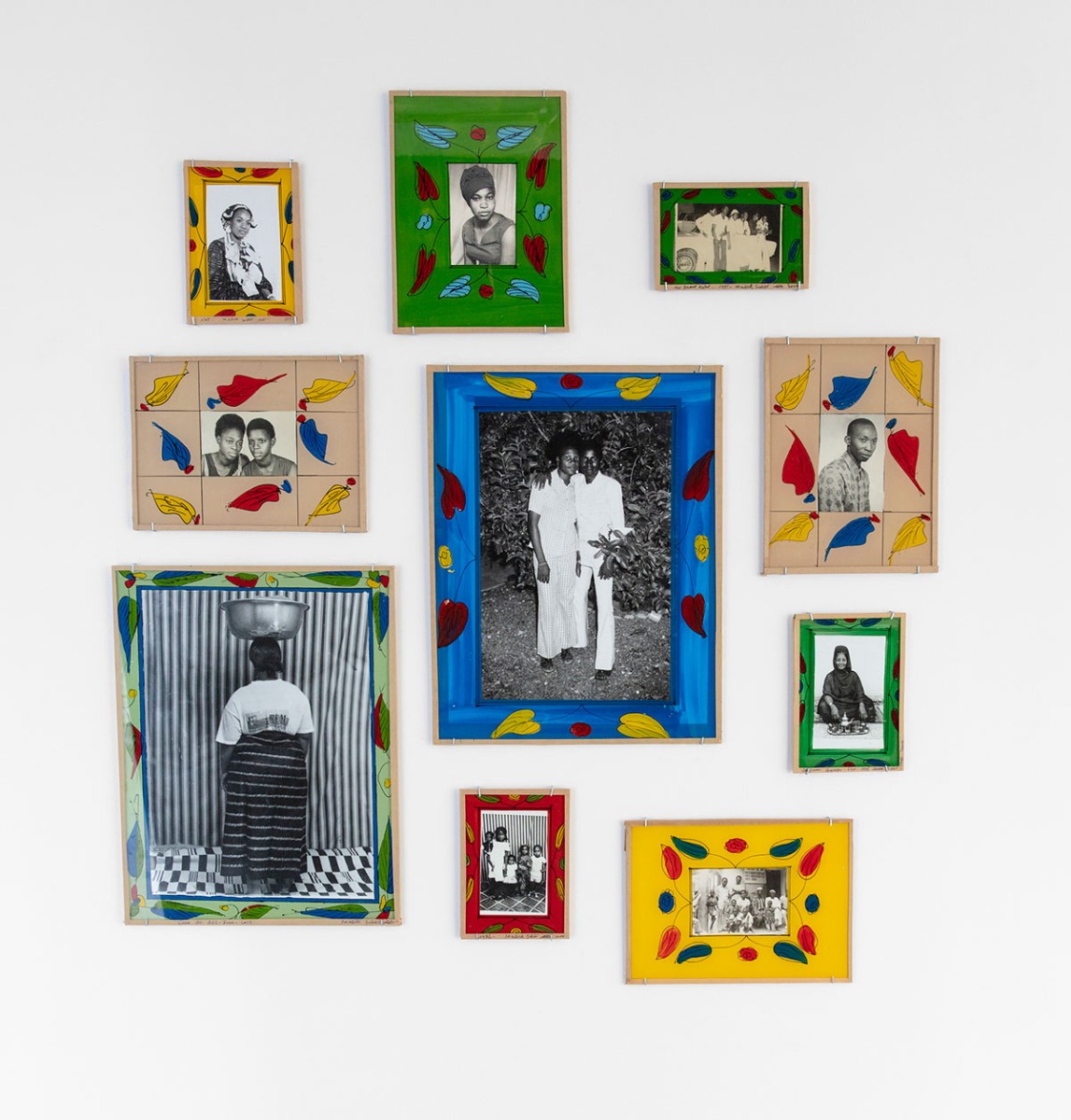
Exhibit: Migrations of Line: Julie Mehretu and Antoinette Bouzonnet-Stella
My tutor had suggested that I look at Julie Mehretu, so I was quite happy to see a collection of five of her works in one hall of the AGO. When I initially looked at the pieces they struck me as graphite on paper, just via the nature of the colours of the lines. I could almost feel the frenetic sound of a pencil, in creating a piece like this and yet this is an etching.
When I saw these works, I saw fences and clusters of white pine needles. Birds, and small animals. They feel like landscapes to me. In the one below, I see the roots of a fallen tree, and all the chaos of the moment of its fall.

Exhibit: Matthew Wong: Blue View

I didn’t stay long in the Matthew Wong exhibit. the intensity of the blue was a bit much very quickly, for me. I stopped seeing the works and started only seeing the blues. Which, I suppose, is an interesting result in and of itself.
However, the Starry Night painting caught my attention. Obviously there is a connection to Van Gogh here.
Years ago, I’d attended the AGO’s Mystical Landscapes exhibit. I had gotten quite close the Starry Night over the Rhone at Arles (much to the annoyance of security, I’m sure) to look at the impasto. What caught in my memory is how the stars were rendered and it was this memory that returned as I looked at Matthew Wong’s Starry Night and ultimately lead to me taking note of the piece in my sketchbook.
