A moment of reflection
It was fascinating to watch my own progress through this project. I had set myself the task of exploring Memory, and so I shouldn’t be too surprised about where it went. My stepping off point was family stories, though quickly it became reflections on my own memories.
I don’t reflect much on my childhood, or growing up. I don’t remember most of it. Growing up different in the 80s; growing up queer; What memories are there are mostly lonely. Many of my memories are referential through others: Those who knew me then, relating stories.
This project could go much further. I created a handful of pieces, though I’m sure I could fill in the empty spaces in this project with more.
Early Ideas
At the beginning of the project, where I knew my subject was Memory though my theme was closer to Change (and the fear associated), I’d started sketching ideas that were very much related to figure.
I’d actually started into the thinking of the project while still in Part 4. I spent half of that section thinking about this project, so some sketches align to the work i was doing then.


In these sketches, I’d considered pulling abstract elements from Klimt’s designs, or using collage with mulberry paper. The drawing itself would be done by watercolor pencils and pastels.
I’m sure there is something here I could pursue for something else, but I quickly realized the shallowness of the well in terms of the idea for this project. I went back to the drawing board, staying with Memory, and landed on my family’s stories.
As I mentioned in my project proposal, this would allow me to pull in literal threads from my mother’s practice, and combine it with techniques and methods I’d learned while studying this unit.
Materials
Fiber

I’d decided, back in Part 4, that my mother’s work would be included in this project.
My mother uses quite fine yarn on her loom, and that presented challenges. In the final works, I blended my mother’s fibers with more harshly coloured, commercial cotton embroidery floss. They both gave me different effects, and I really liked the results.
Holbein Multi-Drawing Book

Holbein has discontinued a line of multimedia sketchbooks. The paper is fairly heavy, nicely textured, and reasonably well bound.
One of my local art stores had purchased the entire remaining stock in Canada, and I’d picked up one a year ago just to test it out. I quickly realized it was a great sketchbook for oil painting — once the paper was primed. I went back to the art store, and bought every remaining sketchbook they had, in all sizes available. I can be a bit impulsive.
Early in the process of this project I was struggling with format. A light bulb went off when I thought of building the works as pages in a book, and the floodgates opened in my mind.
Mulberry Paper

I have a collection of fascinating traditional Japanese paper samples. They have intriguing colouring, patterns and textures, and I thought they’d fit very well with my works.
I discarded this idea. The paper was difficult to work with, alongside the embroidery, but also the paper was too intense in comparison to watercolour elements.
Dried Flowers

I have an eclectic collection of stuff for making. I had thought about using dried flowers to help with some aspects of the designs. Creating organic aspects via the collage dried flowers.
I discarded this idea as well, after attempting one work and disliking the result. Instead of iterating with the materials, to find another path forward, I decided to pivot entirely and discard this idea.
Sketches
As I considered the works, I found myself working like I did back when I was learning how to do comics: do all my quick sketches, then lay in all my pencils, then do all my inks, etc. This didn’t hold fully, but I did all my initial sketches at the same time.
Then, as I was working, and my ideas began becoming material on the page, I’d edit and refine.


Warp and Weft
In my first pass at Aunt Francis and Potpourri, I thought about trying to weave parts of the image. Constructing a loom of my mother’s fibers, directly into the image. Then, use methyl cellulose to redirect the threads off the warp and into organic forms.
Perhaps this might work, but at this scale it was nothing but frustration and mess. This piece led to quite an art block, that was only broken by my settling on the Holbein sketchbook format.
It was this work that convinced me that dried flowers, and the art paper was not the path I wanted in this project. I also discarded the idea of having such literal backdrops of my grandmother’s house.


It doesn’t come across whatsoever, but I was thinking about Wayne Thiebaud as I was considering how to get the warp to be drawn into shape. I was introduced to Thiebaud via the Modern Arts Notes podcast, episode 324 2. The episode was replayed over Christmas 2021, on the event of the artist’s passing.
When I saw this painting, and a few similar ones by Thiebaud, I was immediately struck by how much like textile it looks. If I could figure out how to affix the threads, I’d love to do a fiber-based study of this painting.


Creating Space
A common conversation between myself and my Tutor was about the Space within an image. In particular, my habit of leaving backgrounds white. I can’t say I fully resolved that habit in these works, but I did spend a great deal of time thinking about the space created within the images.
Fibers leapt into the foreground, and even closer to the viewer. Ink and watercolour fell backwards into the middle ground and background. Where it made sense to the image, I tried to play between the layers to produce interesting spacial effects.
What is Real
Reflecting on my use of the ink, watercolour and fiber, I noticed a motif of sorts in my work.
When I planned out this project, the fibers of my mother’s loom were to echo my mother’s voice in the stories. This expanded in concept to start representing anything metaphorical, or dreamlike associated to the events.
This moved the watercolour and ink into the role of representing the ‘physically real’ aspects of the story. this doesn’t hold perfectly, but is common enough that it jumped out at me.
This juxtaposition is interesting, given it is the thread that jumps off the page into three dimensions and it is the watercolour and ink that remains flat.


As I was thinking about the green lawn of this painting, I thinking about how to show a thick painted impasto using fiber. In particular, Thiebaud’s Painting from Wimbledon for Sports Illustrated. Although unlike I linked further up, it still reminds me of closely clustered fiber.
Aunt Francis and the Potpourri
Dinner was delayed, and everyone was getting hungry. Aunt Francis, whose eyesight hadn’t been good for many years, was happily snacking on the bowl of bits&bites that Grandma had put out. Of course, the bowls of snacks had already been emptied and cleared away. Aunt Francis was eating the potpourri


I had the thought that there would be an audience to the events, as the story took place at a dinner party. I dislike them now, and if I redo this, I will rethink the figures.
Grandma’s Brownie Box Camera
The last conversation I had with my grandmother, was late at night in her living room. She told me stories of her youth, taking her brownie box camera up into the mountains of Alaska to take pictures.
I wonder what happened to those pictures.


By coincidence, I was creating this work on the date of my Grandmother’s birthday. My Uncle Stu posted this photo on social media, and I couldn’t ignore the serendipity.
Dancing with Spiders
A memory of a blackwidow spider in my grandmother’s house, reminded me of a story of my father’s. As a kid, he and his brothers would collect blackwidow spiders in jars. Then, in the way that only young boys can possibly consider “smart”, they’d dump the spiders on the floor and kick them about with their bare feet.


My Thirties were About Pain
I spent my thirties in severe pain. Nearly crippled by sciatica that rendered my left leg randomly paralyzed. Learning functional exercises with kettlebells, and incredibly painful stretching, finally corrected the problem.


I wanted a prison. Broken bars. I don’t consider this a particularly strong work, and maybe I’ll revisit it in the future. Though I’m not sure what I’d change.
Martin and the Goose
My mother relates a story of a visit to her Aunt Shirley’s farm when I was a toddler. They had a goose that would attack my great Uncle Chester, or any other adult. but not me. The goose and I were friends.

Since I was quite young — perhaps even before I was born — this print has hung in my parent’s house. I have never been able to find an image of it online, though it is registered in the National Gallery of Canada’s database of Inuit art. I recently traveled back to my parent’s and was able to take a rather bad photo, so I could record it here in my log.
The print tells a story of a sorcerer who disguises themself as a polar bear, high in the arctic. Two Canadian geese begin harassing the polar bear, and in response the bear grows these additional goose heads in order to defend themself. It was from here that I gained much of the idea to use the personal story of myself with the goose on my Great Aunt Shirley’s farm.

The Doctors all said his story should have ended
In my teens, my father fell of Mount Andromeda in the Canadian Rockies. The injuries he suffered were both incredibly severe, and far less than they should have been given how far he fell.
He walked seven hours out to the ambulance.


I needed this work to be simple. What does the mountain mean? Can you see the frayed rope? The plants that grew strong after the accident? Would you know what this meant if you didn’t know the story?
C
At the time I was finishing Part 4 of this unit, my mother was diagnosed with cancer. I had been creating pastels, with my blue nitrile gloves. The pastels were a particularly bloody shade of red. I knew I needed to work these coincidences together.
The cancer is minor. As I type, she has begun radiation treatment. She’ll be fine, physically, but emotionally this takes its toll.


Cancer grows its loops and lesions throughout the body. I wanted it to invade the viewer’s space, and look organic. Creating ribbons by bundling up the threads and looping them around a structure of straight lines.
Most of these threads are from my mother’s loom. My mother’s body.
There are three or four knots made of commercial cotton fiber. Invading. Seeds that twisted the rest.
Review
Recognizing that my perceptions here are quite biased, I definitely have a view of what are the strongest pieces
Two very personal stories make up what I consider the strongest in the set. My last conversation with my grandmother, and a moment when we thought my father had died.
In both, I like the balance of realism and abstraction. Strong watercolour elements, and lines created via thread.
I enjoy how ambiguous the camera is in it’s drawing. “What is that?” well, unless you know you won’t know. In many cases, that is the story of both pieces.
Discoveries

Following my completion of this project and while I was preparing for assessment, I showed some of the works to my mother. In particular, Grandma’s Brownie Box Camera. This led to my mother digging in closets, to recover one of the photographs from the trip that my grandmother told me about.
Amusingly, the colour didn’t surprise me (it didn’t even register that it was in colour, honestly) but rather the ‘painted’ quality to the pine tree needles. My mother, very patiently, reminded me that this was a black & white photograph enhanced with watercolour paint.
This photograph now hangs in my studio, gifted from my mother.
My conversation with my tutor reminded me that I had left some critical components out of my write-up. We had discussed some of my influences, and touched on where some of my ideas arose, but that was neglected in the write up. We also discussed how this collection might be presented. I’ll consolidate those responses below.
Context and Critique
While I was working on Assignment 4, and doing prep work for this project, I had done a great deal of internet searches for artists that incorporated thread into their works. Some I passed over quickly, and some got pride of place in the form of a browser tab opened to their artist websites.
A visit to the MOCA also firmed up many of my ideas, early on in the process.
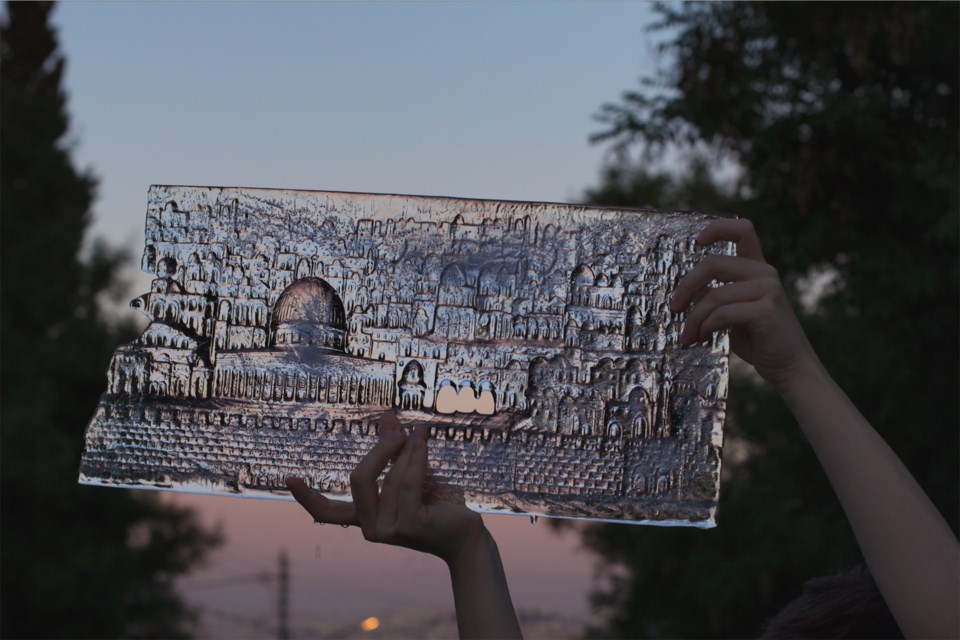
Nours.
Nour Bishouty
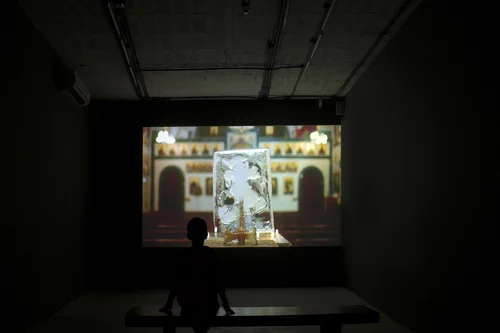
I had attended an exhibit at the MOCA, here in Toronto, where I first encountered Nour Bishouty’s work in the form a video installation, Aḏrāʾ Samar, showing her ice sculptures melting in situ of mundane locations. Her sculptures are created from religious icon moulds that her father once used in his own artistic practice. In the video, the artist has used the moulds to shape ice, and then placed them in the contexts those icons would have been used and recorded them melting.
Watching the video was a profound and moving experience for me. I believe this is where I decided on using my mother’s thread in the works. Of embedding my own sense of nostalgia — and inevitable loss — of my mother’s art into something I am creating.
Mark Newport
I was drawn to how Mark Newport intervened with thread into pre-existing imagery. He was creating something new, out of collage and stitching, but not using those stitches to define a new drawing. They were, instead, working within the pre-existing confines and overlaying a dimension quality. To the right I have shown a detail of his work “Freedom Bedcover: Zachary” which is a quilt made from comic book pages and then embroidered. I like how this plays with preconceptions, and brings fiber craft into the conversation.


Melissa Zexter
Melissa Zexter’s work circled around intervening onto photographs. Unlike Mark Newport, above, she uses the thread to tell alternate stories or to alter the narrative that the underlying photograph provides.
I think you can see a direct line between her work and mine.
Adam Jon Moore
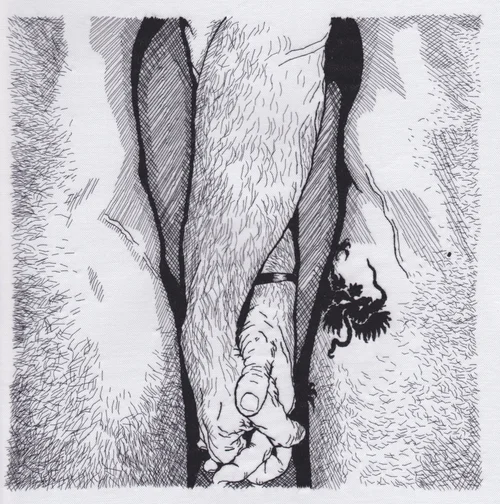
An artist in the LGBTQ+ community, Adam Jon Moore re-interprets gay themed illustrations into embroidery. When I first encountered his work I thought I was looking at ink on paper, but when I realized this was all stitched it led me to consider different ways a drawing might come about.
One of the unsurprising yet surprising discoveries that led off from my stumbling upon Adam Jon Moore’s work is that there is an entire global community of queer artists producing embroidered queer erotica. I really shouldn’t be surprised, as humans will human, but I find it absolutely fascinating the choice of materials and methods that this community has coalesced around.
Further Research
One of the most helpful actions that my tutor takes, is to suggest artists to me. I don’t have as much background as I would like, and building up a practice of visiting galleries is quite difficult to arrange around the time demands of my day job. So having these directions which I may or may not resonate with is extremely helpful.
Kiki Smith
I’m not sure how to think about Kiki Smith as comparison to my own work. they’re a multidisciplinary artist, and have produced a plethora of work. There is a great deal to look at, and yet it is all a bit overwhelming.
A theme I see, particularly in what is presented by the MoMA, is works that focus on body parts and organs. Reading through the interview between Chuck Close and Kiki Smith1, I read a distinct focus on mortality and perhaps the passage from life into death. It is unsettling.
There is also a strong feminism theme, I think, in that interview and how she addresses female subject matter. “Not sexed up” to quote her, from the interview. Quite the opposite: skin peeled back and veins revealed.
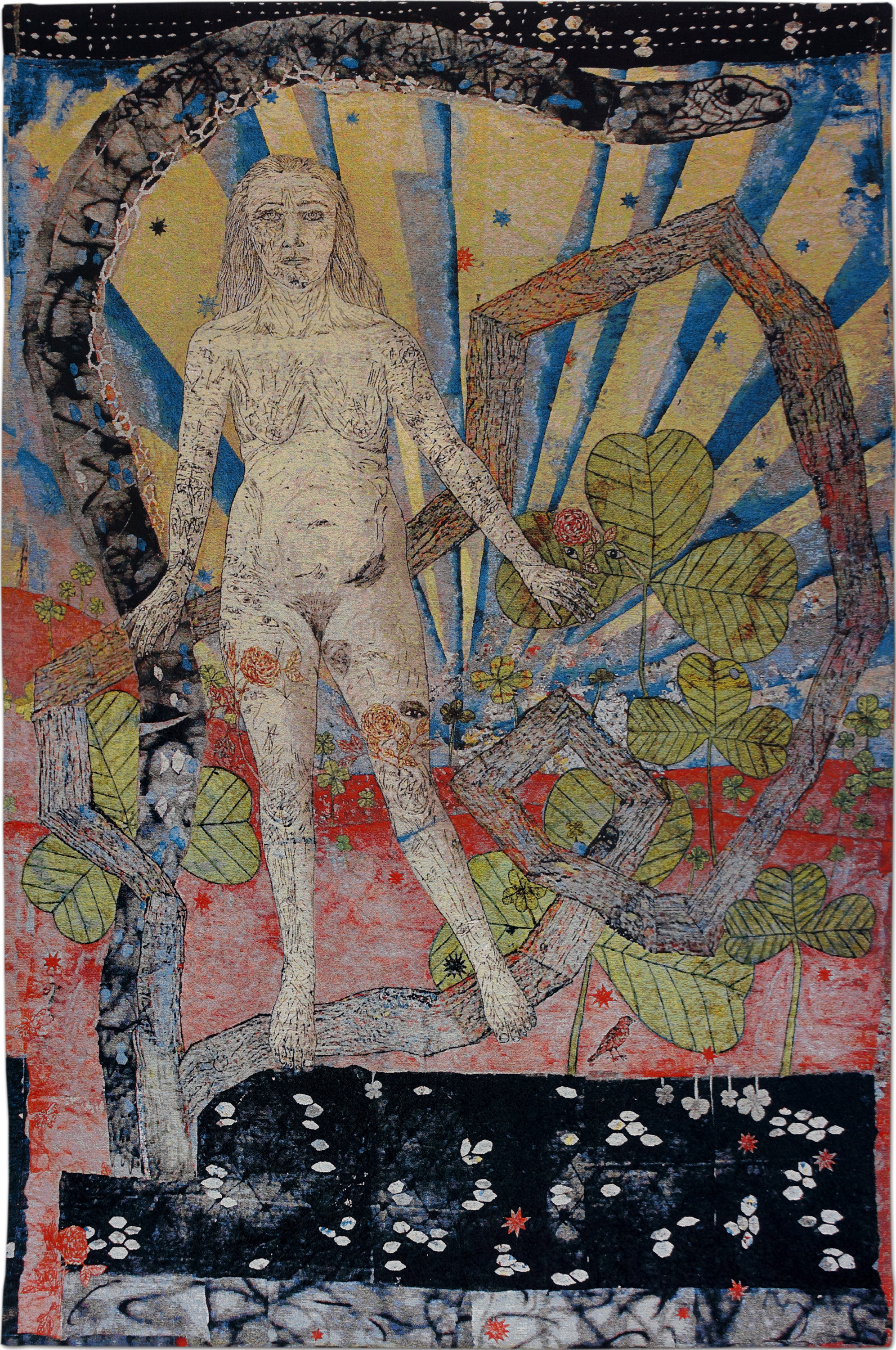
And then I stumble on Earth, a tapestry work. Here, I see something similar to my work in the project. I can see a layering of narrative, and many “personal symbols”. The woman in the image is mature, aging and tattooed. A real person, seemingly, not some photoshoped model. Floating eyes watch the viewer, perhaps turning the viewer’s gaze back upon them?
Its interesting how the figure is balacned between symbols of life (leaves, plants, trees) and more threatening symbols(the snake). Is this an Eden allegory? The snake reminds me of some of my early sketches for this project (seen at top of post).
Nancy Spero
Spero is an interesting artist to contrast against. Her works have strong narratives, often uncomfortable ones. I can see a lot of violence in her work, or rather the recording of violence. What I find interesting is that I don’t always grasp the symbols that are used, until I read the title of the work. Then I’m able to go back and recognize this shape or that as a physical form or representation.
For example Bomb, Dove and Victims (1967). When I first look at this, I see a fountain perhaps, with a bird emerging. Flying humanoid forms are threatening or chasing the bird.
But reading the title, the fountain becomes a mushroom cloud. The yellow trails become indications of incineration.
I find myself thinking about my own planning in this project. How I considered how viewers might not understand the content of a piece because the symbols are personal. Without the context of the pieces, part of the narrative is obscured.


I found Spero’s Black and the Red III quite interesting. A collection of panels, much like this project, each with its own associated story. But, also, taken as a whole they resemble a long scroll and I found myself thinking about my assignment 2 work.
Presentation
As my tutor and I were discussing the works in Pulling Threads, we discussed how their reverse sides held importance to me. Putting the knots on display, as if in some way to reveal the underlying foundations of the story.
I’m not entirely certain exactly why I enjoy the display of the knots. It feels, to me, like putting on display the messy, semi-random way that our personal narratives come about. Pulling back the curtains, so to speak, to reveal the mundane reality.
But, then, of course the questions becomes: how would I show these works if both sides are so important? Once removed from the book, and their physical connection, how would I then reconnect them via the thread of their narratives?
I had a few ideas — some of them a little mad — but none of them feel particularly ‘right’.
- Each piece held in a free standing frame, or fork, such that viewers could walk around the piece. This enables seeing the reverse but doesn’t address the connectivity between pieces.
- Hung from the ceiling, again in frames. The cable that suspends them would be one continuous piece. This cable would ideally incorporate my mother’s loom threads. This feels a bit on the nose, and the frames would need to be heavy enough that the pieces didn’t just flip about everywhere in ambient air movement.
- Building off the frames in the first idea, arranging the pieces in a loop and allowing pathways between them. Their physical arrangement then becomes a thread of sorts, though introduces a linearity that doesn’t make sense.
- From here, my ideas got a little crazy, including Ferris wheel like constructs that would slowly cycle the pages.
1 Kiki Smith by Chuck Close – BOMB Magazine (s.d.) At: https://bombmagazine.org/articles/kiki-smith-1/ (Accessed 21/05/2022).
2 No. 324: Wayne Thiebaud, Minor White (2018) At: https://manpodcast.com/portfolio/no-324-wayne-thiebaud-minor-white/ (Accessed 23/05/2022).