Featured Image: Akunyili Crosby, N. (2012) Nwantinti. [Acrylic , pastel, charcoal, colored pencil and Xerox transfers on paper] 68 x 96 in.
Two of these images have already come up in my learning log, as we discussed compositional terms. I’m going to summarize/synthesis what I wrote there in with the requests from this exercise, and extend them to cover the third image.

At the time of my prior encounter with this image, I wrote of it being busy and garish to my eye. I noted the composition of all these planes moving in different directions, and the cruciform unfolding of the room. The twisted internal space, and the great levels of detail, made me feel uncomfortable — though that wasn’t directly reflected in my writing.
I can see a parallel here in my work for Project 4. I wonder if this is what pushed me there, with the extreme angle on the counter and coffee pot? It must have been in the back of my mind. In my earlier writing on this piece, I had indicated a desire to see more of this in person. I can see the thread of influence there.
I wonder how this perspective was accomplished? the two models are looking at the viewer, while the walls unfold in a full panorama. Did the artist stand on a ladder and swivel around to view the scene? That sounds terrifying, and awkward. Judging from how awkward some of my Assignment 2 process was, I can’t fathom doing it at the top of a ladder. Fancifully, maybe the artist was in the attic and drilled a hole through the ceiling — my mind is far from practical in its ideas.
In terms of tackling the perspective, when I first looked at this image and saw all the lines outside the room I took them for earlier wall placements. But now, following Project 4, could they be perspective lines? planning lines to connect various aspects of the unfolded geometry? There are many written notes on them, but I cannot read them from the images I can source.
Also, these lines exist between the main focus and the papers edge. They’re negative space, sure, but forced not by the items within the view but by the shape of the view itself. I don’t think I’d considered doing that before.
When I was reading the brief for this assignment, I was taken aback by the comment of “two models”. My eyes saw only one, and so I had to hunt. The man had faded into the yellow of the room, and this drew me to the observation of the binary colour palette: yellow and red. It splits the image horizontally, and gives me a sense of downward pressure in the room. The red is sinking or sliding downward. But it also grabs the attention, causing me to not see the yellow items — they just become walls. Could the downward pressure be due to the the angular shape of the rug, and the encircling walls?

I was very strongly drawn to this image. The strange flatness creating an interesting illusory space within which a volumetric women stood out. Although rendered in more neutral tones, my eye sees her as almost superimposed compared to the flatness and strangeness of the rest of the image. Is that just me?
I’m once again reminded of my coffee pot drawing. If I stand up, as I’m quite tall, and mentally interrogate the perspective lines in my environment, I can often find things looking weird if they are quite close to me. Not as weird as this image, but parallel. The green table, and the white cloth-covered table, echo this to me, though there is an extremeness here as if the green table’s edge is turning up as it gets closer to the woman.
I really like how a great deal of depth is achieved through the use of colour intensity. The walls are yellow, but where the back wall falls into shadow it feels real. Sunlight flooding in a window to illuminate a patch of the world, and the rest just receding.
Its interesting that the sunlight doesn’t seem to strongly illuminate the woman, despite the wall behind her. I can see highlights here and there, but I’d expect more if she were in that sunbeam. Is she in front of it?
Does this artist fit in with the impressionists? I feel a sense of Monet and Van Gogh here.
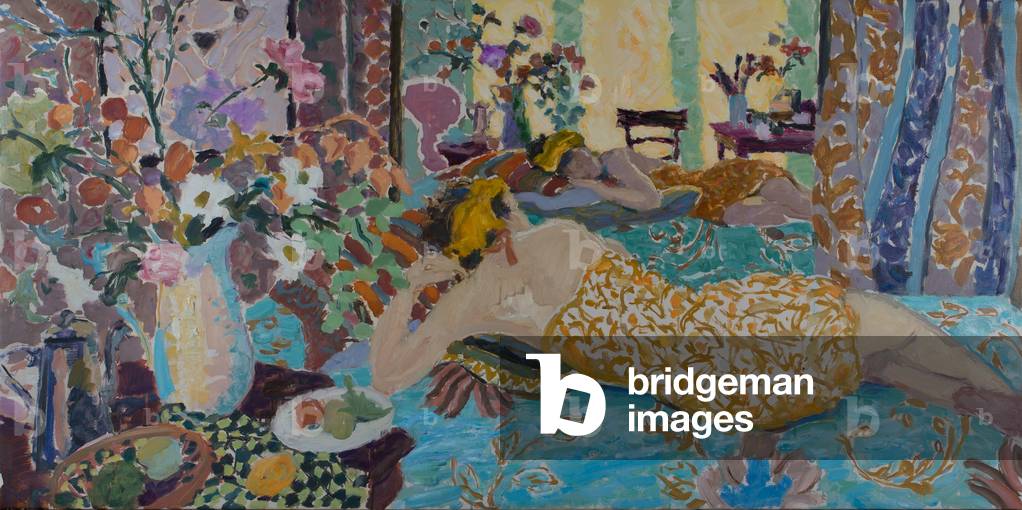
This is not a work by Gaugin but my brain keeps screaming “Gaugin” and inevitably to another Lonely Palette episode*. No, this isn’t Gaugin. This is intricate, and decorative. The large swathes of intense colour are broken up with detail and design. But if I let my eyes unfocus, and let my mind lose track of the detail, I see Gaugin in the margins.
The space in this image is hard for me to see. The flat shapes pull it all into a rug of colour. But if I’m patient, I see the mirror resolve, and the colour shift start to build depth. I see the chair that I’m sitting in as the viewer. I think I’d go mad if I lived in a room this colourful.
When I look at the flowers, I’d expect that to be messy and broken and hard to follow. But I find my mind just handwaving it aside as “negative space”. A sort of “don’t bother with this, it is just to move you back into the frame.” Which feels like I’m being very unkind to the artist.
Not that I need to pull my eyes back, the model’s gaze is on me, nearly from the center of the picture. Its arresting. That window in the picture — the mirror — telling me where I need to pay attention. I’m reminded of Magritte and his overlapping illusions. I think i see a vase of paintbrushes on the table to my right, at least via the mirror. There are flowers there as well, but they don’t seem connected.
That is a weird thought: I am both looking through a window and meeting the model’s gaze, and also I share the room with them though they are turned away from me.
In Nwantiti (featured image), I see echoes of the Bonnard piece. An impression of space, intended towards being understood as the mundane. “There is a room here, this is situated”. I’m fascinated by how the artist constructs the walls of the room: photo transfers of culturally significant items, and album cover art from which this piece’s name is drawn.†
Why is this fascinating? The piece is an intimate moment in daily life. Our lives are defined by the cultural events and moments that surround us, and fill our upbringing. The artist has constructed a bedroom out of those cultural moments. I like this sort of depth and narrative echo. It speaks to me in a way that I want my art to speak — to tell stories not just in the subject, but in the choices I’ve made to construct the subject.

In my own work from Project 4 I see myself starting to play with unfolding space with extreme perspectives, or in assignment 2 as I considered drawing “around” my living room mantel to capture multiple angles.
In project 4, as I pressed in closer and closer to objects, the lines of the room became more and more extreme. As I’m quite tall, naturally I tended to look down. I should spend some time laying on the floor, and seeing what that does to lines of the space around me.
- *http://www.thelonelypalette.com/episodes/2017/1/25/episode-14-paul-gauguins-where-do-we-come-from-what-are-we-where-are-we-going-1897-98
- †Nwantinti (2018) At: https://studiomuseum.org/collection-item/nwantinti (Accessed 27/08/2021).